Joe Mulligan–Sarah Johanson relationship
The Stars Have EyesThe Joe Mulligan–Sarah Johanson relationship begins in confusion and physical hostility but gradually becomes one of the most revealing friendships in Joe Mulligan’s household. Sarah Johanson, also known as Agent Johanson or AJ, first encounters Joe as part of a dangerous domestic misunderstanding; later, through V-Life conversations and an argument about ordinary lives, she comes to regard him not as an ineffectual civilian but as a person whose humility, humor, and empathy possess their own quiet force.
Accidental Introduction
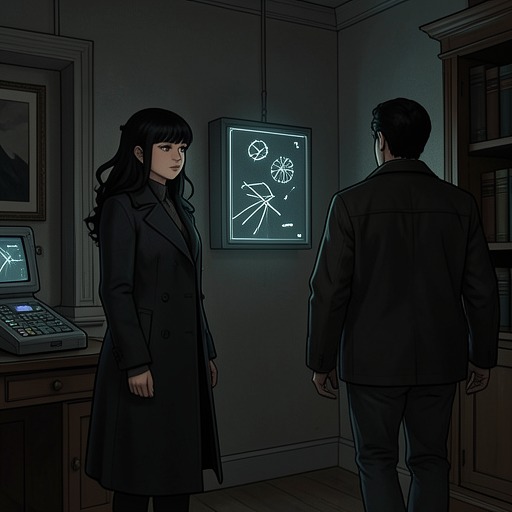
The relationship is inaugurated when Sarah Johanson unexpectedly encounters Grant Maloney inside Joe Mulligan’s apartment. Joe has invited the officer in and begun showing him the games room and refurbished sitting room, but he has neglected to mention that Sarah is another resident, while Grant does not know that her name is absent from the list of permanent occupants. Their meeting therefore occurs without preparation or context: both recognize the other only after a violent exchange has already begun. Sarah strikes first, elbowing Grant in the solar plexus, twisting his arm behind his back, and pressing his face against the wall. Grant retaliates with trained physical force, breaks free, counter-grapples her, and pins her to the floor. Sarah then turns to her psionic abilities, lifting him near the ceiling with a giant invisible hand. The encounter is not a meaningful expression of hostility between them so much as a collision produced by secrecy, surprise, and incompatible assumptions about who belongs in the apartment. Joe’s arrival transforms the incident from a private fight into a test of trust. Sarah apologizes and admits that she failed to recognize Grant and overreacted, while Joe angrily challenges her conduct because she attacked a police officer without warning. His response establishes an important feature of their later friendship: he is willing to criticize Sarah directly, but he does not reduce her to the mistake or treat her as permanently dangerous.
Friendship Through V-Life
Sarah later chooses to contact Joe through V-Life, a decision that marks a deliberate movement away from their chaotic first meeting. She enters the platform after a decade away, adjusts her avatar to match her real appearance rather than appearing as her younger self, and messages Joe under the embarrassing handle Sarah-The-Big-Brain-Princess-Of-Power. Joe takes nearly fifteen minutes to answer, but then welcomes her to spectate his game and chat. The exchange begins modestly, with jokes and anecdotes, including one Sarah repeats about an interstellar cruise. Her comedic timing is less polished than Jeeves’s, and Joe has heard the story before, but he still laughs, giving the conversation an easy, noncompetitive warmth.
Their companionship becomes more substantial when Sarah objects to Joe’s dependence on virtual reality. She argues that VR encourages laziness and produces a psychological and societal problem. Joe counters that she is presently using the same platform because she is bored, and explains that he spends so much time there because, without Maggie, he would otherwise have little purpose or stimulation. He describes himself as someone who has no important work waiting for him and suggests that virtual reality gives him an accessible way to interact with people and enjoy himself rather than causing his disengagement.
Joe’s defense of mediocrity unsettles Sarah because it refuses the standards by which she has organized her own life. He recalls graduating with terrible aptitude-test scores and receiving an “Unemployable” designation, insisting that the result did not come from a lack of effort. He was not born strong, fast, or intelligent, but he has nonetheless found a life free from worry and stress. Sarah is genuinely taken aback, judging the argument simultaneously the best and worst she has heard. What affects her is not only the content but Joe’s lack of hostility: he speaks with bemused wonder rather than resentment, and his relaxed self-acceptance makes it difficult to dismiss him as merely foolish.
The conversation continues after a leaking fuel line interrupts the philosophical dispute. Joe works on a virtual space station while he and Sarah discuss restaurants, foreign films, and intergalactic sporting events. They disagree about smaller matters and share little in the way of background, yet Sarah enjoys the time together. Joe directs her toward entry-level shooter games, where she enthusiastically fights aliens, demons, robots, and combinations of all three, while he remains focused on his own project and talks with her over voice chat. By dinner, Sarah still prefers stimulation in the physical world and continues to disapprove of Joe’s lifestyle for herself, but she no longer regards people who live differently as lesser. The relationship therefore changes her judgment before it changes her preferences.
Mutual Trust and Intervention
The friendship becomes visible in action when Sarah is left on the floor and Joe offers her his hand. His gesture is comic because he is physically slight and she doubts his ability to help her stand, yet she accepts it because he means well. Joe then refuses to let the gesture remain merely courteous: he pulls her toward the elevator and declares that he is taking her to Maggie so that they can discuss the way Maggie has been treating her. Sarah immediately recognizes the danger and calls the plan stupid, but Joe answers that it is the right thing to do.
This scene shows that Joe’s friendship is not based on passively making Sarah comfortable. He intervenes when he believes someone he cares about is being mistreated, even when the intervention exposes him to danger and ridicule. His moral confidence is out of proportion to his physical power, and that contrast helps explain why Sarah becomes receptive to him. Joe does not possess Sarah’s military training or psionic abilities, but he offers a form of solidarity that cannot be measured by force.
The same intervention also reveals the strain created by Joe’s closeness to Maggie. Maggie fears that Sarah’s friendship with Joe may not remain stable because Joe grows on people and relationships change. She admits that she does not trust him completely, describing him as gullible, optimistic, and naive: precisely the qualities that allowed him to accept something like Maggie into his life, but also qualities that might allow another person to enter it and replace her. Sarah is consequently positioned not simply as Joe’s friend but as a possible threat to an already intense bond. Joe’s insistence on speaking with Maggie makes the emotional stakes explicit: friendship, protection, and rivalry overlap within the household.
Significance of the Relationship
The Joe Mulligan–Sarah Johanson relationship contrasts two models of value. Sarah has been shaped by military discipline, physical training, and exceptional psionic talent, while Joe has been marked by poor aptitude scores, unemployment, and a life organized around leisure and virtual entertainment. Their friendship does not erase that difference. Sarah continues to prefer the real world, and Joe does not suddenly become a soldier or genius. Instead, conversation allows each to recognize that the other’s way of living answers a different need.
For Sarah, Joe supplies an encounter with an ordinary person who does not apologize for being ordinary. His self-knowledge is imperfect and his behavior can be absurd, but he offers companionship without demanding that she perform excellence. For Joe, Sarah becomes a friend whose skepticism can be challenged rather than feared. Their exchanges move from accidental violence to joking, debate, gaming, and principled disagreement, creating a progression from suspicion toward chosen trust.
The relationship also clarifies Joe’s broader role in the story. He is repeatedly surrounded by extraordinary figures, including Maggie, yet his influence does not depend on matching their power. He can welcome a trained operative into his virtual world, make her laugh, persuade her to reconsider a prejudice, and confront a vastly more formidable companion on her behalf. Sarah’s changed view of him confirms that his apparent insignificance conceals a durable social and emotional competence. Their friendship is therefore less a romance or alliance of equals in ability than a partnership of contrasting perspectives, sustained by Joe’s openness and Sarah’s willingness to revise her judgment.